


Enterprise software is in a paradoxical state: while developers and software vendors bring new AI tools, cloud services and automation solutions to market in monthly leaps, many people responsible for logistics and IT are struggling with the basics in their day-to-day work. The gap between what would be technically feasible and what actually arrives in the company as business value in practice is growing visibly wider.
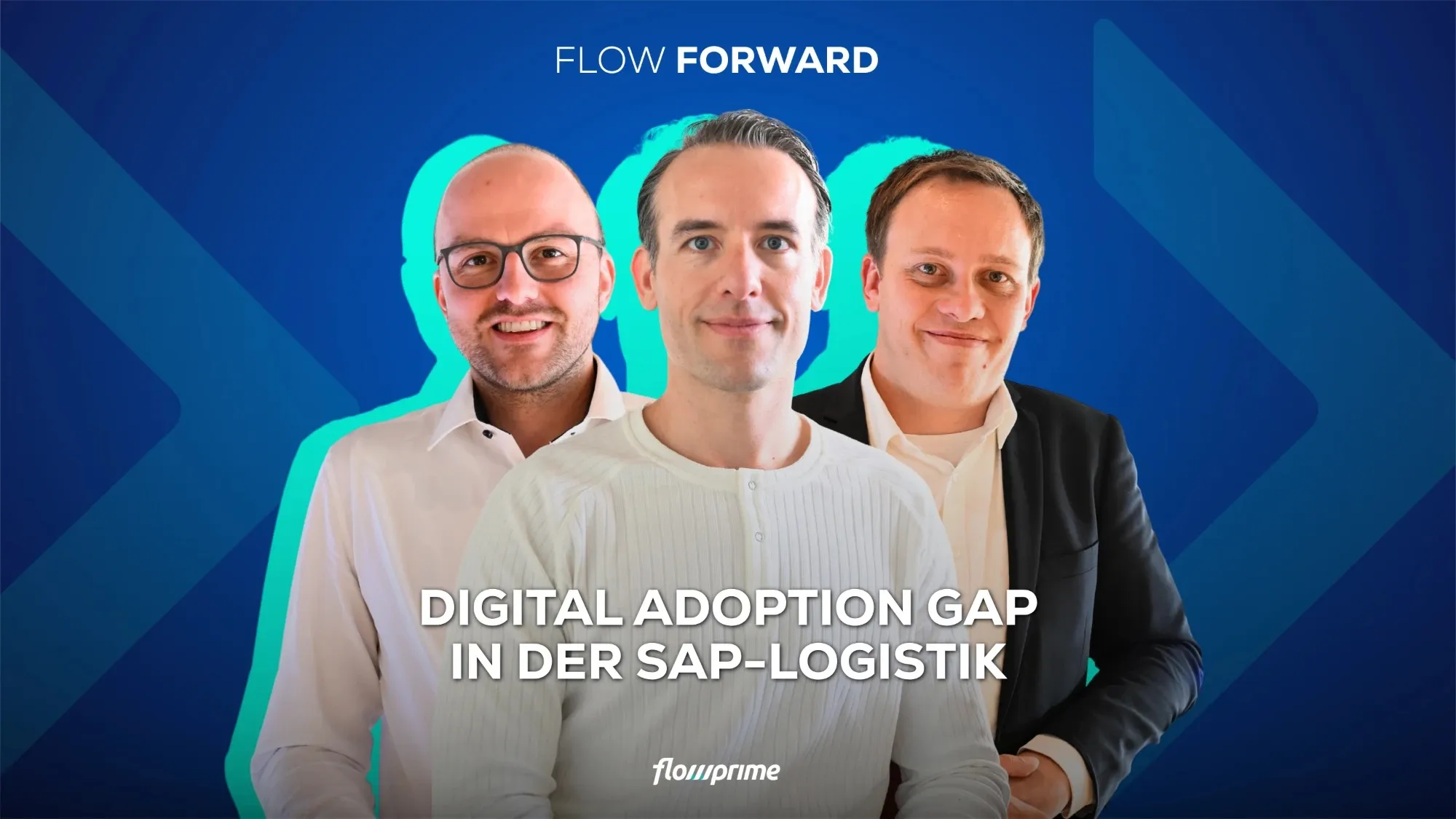
This phenomenon is the focus of an episode of the Flowprime podcast Flow Forward – Intralogistik trifft SAP. In it, the experts Jan Hummel, Jannik Sandfort and Daniel Chrobot shed light on the causes of this so-called digital adoption gap, take a critical look at classic SAP consulting practice and show how companies can once again achieve real impact in their material flow through pragmatism and targeted experiments.
1. What is the digital adoption gap?
The digital adoption gap describes the exponential divergence between technological potential and the business value actually realised. At conferences and trade fairs such as the DSAG Annual Congress, AI agents, highly integrated platforms on the SAP Business Technology Platform (BTP) and automated workflows are in the spotlight. In the operational reality of many warehouse and production sites, by contrast, manual paperwork, Excel shadow IT or confusing process chaos still dominate.
- Technological potential
- Business value realised
- Digital adoption gap
| Dimension | Technological development | Organisational reality |
|---|---|---|
| Innovation cycle | Exponential (1–2 years) | Stagnant to linear (10–30 years) |
| Focus | Wealth of features, AI, cloud, BTP | Stability, habit, risk minimisation |
| Core problem | Overwhelming range of offerings | Lack of capacity & process transparency |
| Typical reflex | Buying the next software tool | Clinging to familiar workarounds |
As Daniel Chrobot explains in the podcast, the cause of this gap lies in the mismatch between development cycles: while technology providers innovate in yearly or even monthly leaps, established industrial and retail companies tend to think and act in decades. Many systems are introduced with the prospect of a maintenance commitment lasting decades – an attitude that, at today’s pace of innovation, inevitably leads to a massive backlog.
2. Glossy trade fair stands vs. everyday life in the warehouse: where the pain really lies
The reason why many digitalisation initiatives fail is rarely technological inadequacy. The real problem lies much more at the human and organisational level.
“The pain rarely lies at the technological level, but with the people and the processes. The conflicts that companies have to face concern their willingness to really tackle established habits in the workplace.” — Daniel Chrobot on the Flow Forward Podcast
In practice, three key blockers in particular can be observed that widen the digital adoption gap:
- Escaping into technology instead of cleaning up processes: If processes in the warehouse or in production control are unclear, even the most modern software will not help. Adding new tools on top of messy workflows merely digitalises the existing chaos.
- Fear of uncomfortable conflicts: Changing established ways of working takes courage. If managers shy away from questioning and restructuring familiar workflows – for example those of long-serving employees – the technology remains ineffective.
- False promises from the market: Many software vendors fuel the illusion that complex master data problems or logistics bottlenecks could be solved simply by using a large language model (LLM) or a new app. Without clean process foundations, however, this is a fallacy.
3. The role of SAP consulting: an end to pure “A-to-B migration”
A major driver of the digital adoption gap can also be found in the traditional consulting model. For years, service providers profited from pure “lift and shift” projects – such as the purely technical migration from SAP ECC to SAP S/4HANA (brownfield) without touching the underlying logistics processes.
In the conversation, Jan Hummel and Jannik Sandfort stress that a pure system changeover without functional process optimisation does not generate any significant added value. An S/4HANA system that is operated exactly like a 15-year-old ERP system wastes the entire potential of modern standards such as SAP EWM, Fiori or automated material planning.
Future-proof SAP consulting is therefore characterised by the following principles:
- Business process before system logic: Only once it is clearly understood how material, data and decisions flow through the operation is the right SAP architecture designed.
- Honest straight talk: Consultants must have the courage to advise against unprofitable or premature uses of technology instead of chasing every trend.
- Focus on real enablement: The goal must be to build up knowledge at the customer so that the internal IT and logistics team can develop the system further independently.
4. How companies can effectively close the digital adoption gap
Bridging the gap between technological possibility and real benefit does not require more mammoth projects, but a culture of pragmatic sharpening and targeted experimentation.
-
Step 1: Targeted selection instead of fear of missing out (FOMO) Companies should not install technologies out of fear of missing out. Every tool must be measured against concrete operational goals: higher throughput, shorter lead times, fewer picking errors or less strain on employees.
-
Step 2: Early testing in a protected setting (PoC & sandbox) Instead of spending months writing specifications, proofs of concept (PoCs) and agile workshops bring clarity quickly. As Jannik Sandfort explains, a test environment (sandbox) can be used to check within a few days whether a Fiori app, an EWM standard process or AI-supported document reading works in the specific customer context.
-
Step 3: A culture of “fail often and early” Insight comes from doing. If a prototype is tested in a small group and turns out to be unsuitable, this is not a failure of the overall project but a valuable and inexpensive gain in knowledge. It protects the company from flawed investments worth millions.
-
Step 4: Bringing people at the workplace on board Whether at the packing station, on the forklift or in shift management: user acceptance determines the success of every IT system. Simple, role-specific interfaces (such as SAP Fiori) and easy-to-understand onboarding ensure that the system is actually used in everyday work and not bypassed.
5. Conclusion: first the goal, then the tool
The digital adoption gap does not arise because the technology is too poor, but because it is often considered in isolation. If you want to make real progress in logistics, you must not see technology as an end in itself, but as an enabler for lean, transparent and resilient processes.
The insight from the discussion between Jan Hummel, Jannik Sandfort and Daniel Chrobot is clear: the key lies in the courage to address the real pain points in the company openly, to simplify processes consistently and to test new approaches in small, controlled steps. Only when people, processes and SAP technology mesh seamlessly does technological innovation turn into measurable success in the material flow.
PeopleProcessSAP technologyMeasurable success in the material flow